Marketers lose the right to choose their tools. Do you have to let it go?

Manago AI is the new name for SALESmanago. Read our rebrand story here
by Aleksander Skałka, Director of Solutions Consulting & Sales Enablement
Observing trends among the greatest eCommerce players, marketers from small and medium companies must wonder, how did this happen, that their daily challenges differ so much from the problems that bother the biggest industry’s players? Latest observation: marketers lose the influence to choose and operate their tools without IT support. But should this concern you, a marketer for small or medium company? Let’s dive in.
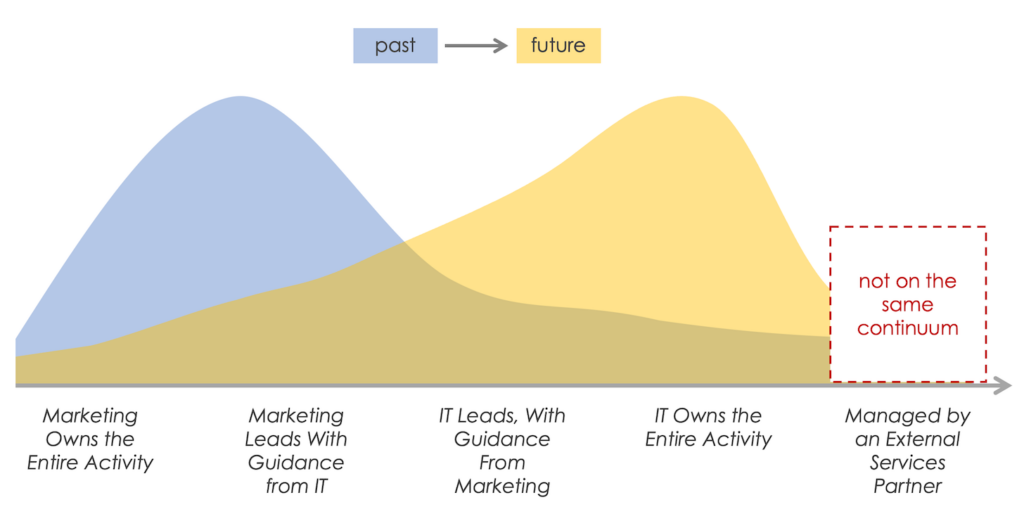
Scott Brinker, called deservedly The Godfather of Matrech, has observed that IT owns increasingly more marketing technology activities, like choice, maintenance and governance, including the acquisition of budget for it.
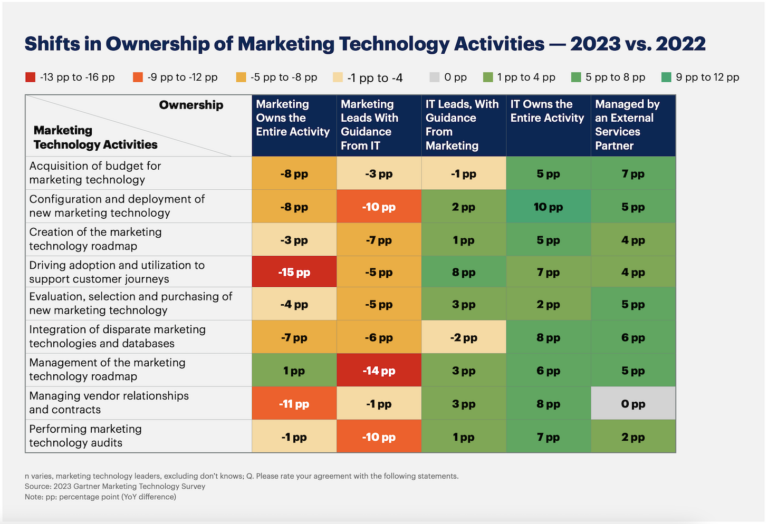
source: chiefmartec.com
This trend unveiled through a Gartner report primarily focused on sizable companies, indicates a transformative shift in the ownership of martech responsibilities from marketing to IT. As we delve into this trend, the question arises:
As a marketer, working for a small or medium company, should you pay attention to this? Maybe this is a phenomenon exclusive to large companies, or maybe it will eventually reach your company anyway, because this is an inevitable way martech and, in a more specific sense, eCommerce evolve.
In our opinion, yes, you should pay attention, because it will decide on your future and the efficiency of marketing processes in your company. And no, it is not inevitable. Furthermore, your position gives you the power to choose, how the future will unfold in your company, and how much influence over your stack will remain in your hands – exactly because you work for a small or medium company.
Brinker’s insights reveal a noteworthy transformation in the martech landscape, primarily observed in larger entities. The Gartner report indicates a tangible shift in ownership of martech activities from marketing to IT.
Various aspects, such as the configuration and deployment of new marketing technology, acquisition of a martech budget, creation of martech roadmaps, and integration of disparate technologies, have seen a notable move from marketing to IT.
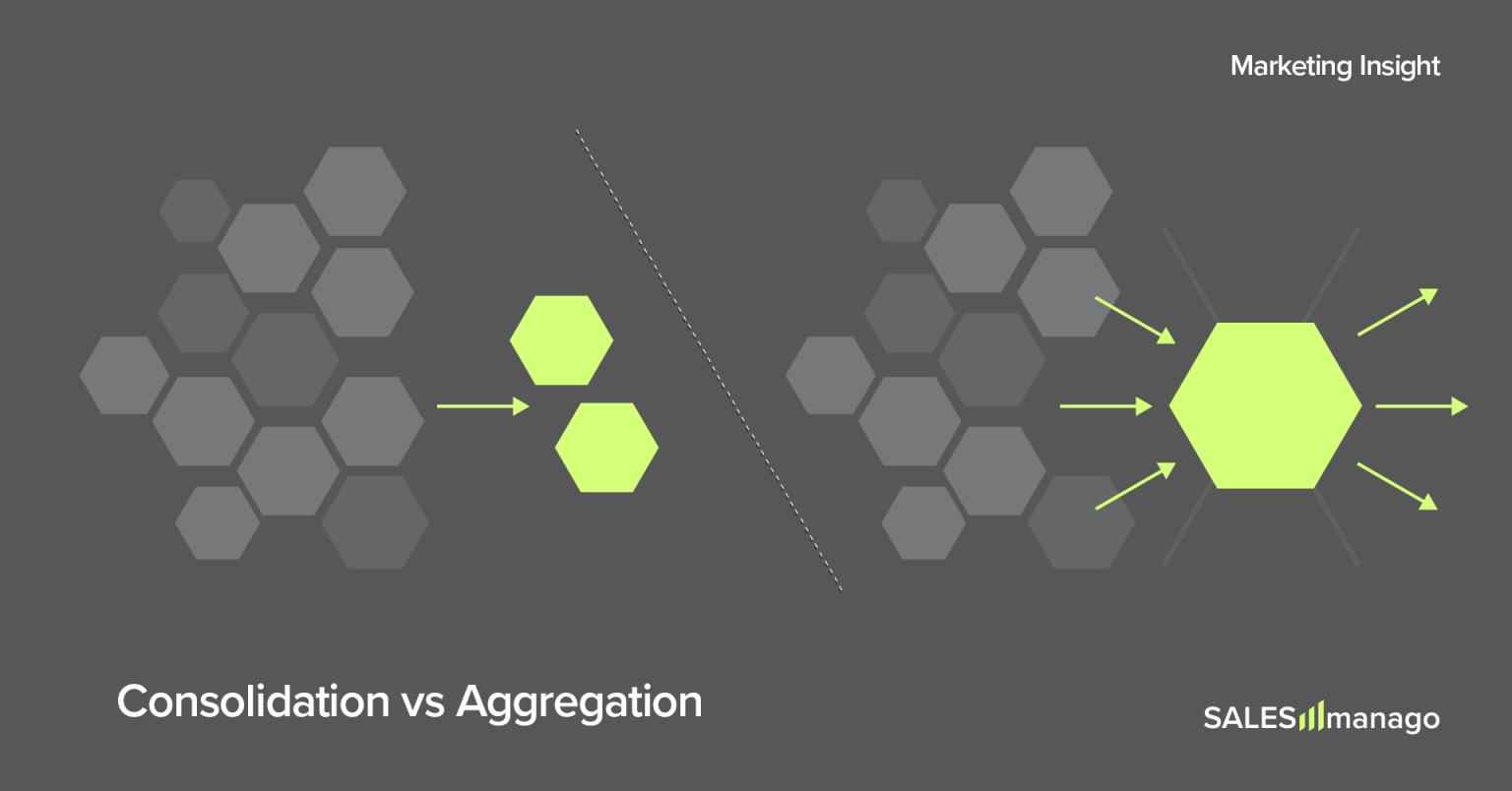
The driving force behind this shift is identified as the age of aggregation in tech stacks.
To better understand the mechanism, let’s define the driving factors.
According to Brinker, consolidation of the Martech stack refers to the strategic integration and rationalization of various marketing technology tools and platforms within an organization. It involves streamlining and optimizing the marketing technology ecosystem to enhance efficiency, reduce redundancy, and create a more cohesive and manageable set of tools for achieving marketing goals.
Scott Brinker does not specifically use the term “aggregation” in the context of marketing technology (Martech) in widely known contexts or frameworks. However, in the broader tech context, aggregation often refers to the gathering or collection of data or services from multiple sources into a unified view. In a Martech context, if someone uses “aggregation,” they may be referring to the practice of bringing together data or functionalities from various marketing technology tools or platforms to gain a comprehensive understanding of marketing performance. Keep in mind that the terminology used in the rapidly evolving field of Martech can vary, and it’s always good to refer to the specific context in which the term is used.
Rather than simple consolidation, the trend is toward aggregation, where diverse applications in a tech stack work together seamlessly.
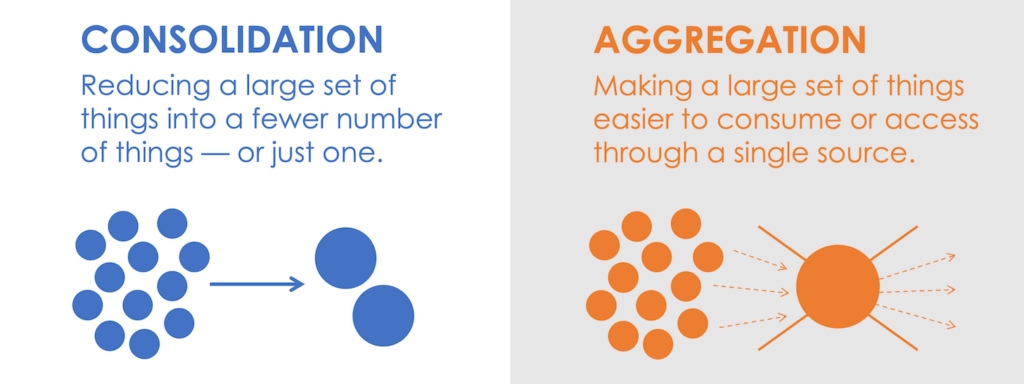
source: chiefmartec.com
Aggregation occurs at different layers within the tech stack, such as data, workflow, UI, and governance, and is facilitated by horizontal aggregation platforms managed by IT.
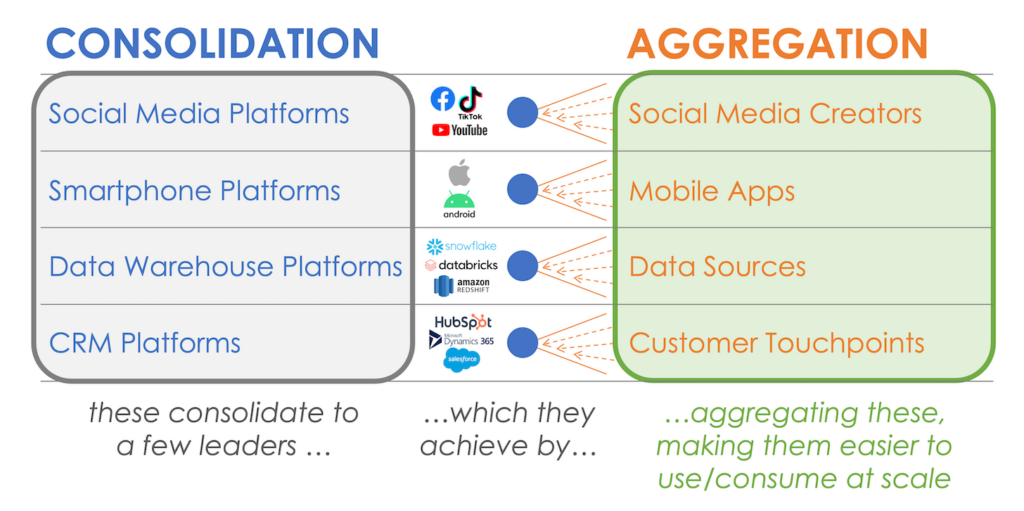
source: chiefmartec.com
The article suggests that this shift is a positive development for marketing. It allows marketing operations to focus less on managing technology infrastructure and more on building better processes, experiences, and employee/customer enablement. Additionally, the aggregation platforms open up new data and cross-organizational services for marketing to leverage, supported by the technical expertise of dedicated IT and data teams.
source: chiefmartec.com
The author envisions a future where marketing operations will increasingly compose automations, analytics, and custom apps on aggregation platforms, providing greater agency in shaping how marketing operates. Overall, the shift from marketing to IT ownership in martech is seen as a promising development that heralds an exciting future for inclusive martech.
Is an aggregation a phenomenon, that should concern smaller eCommerce players, and if it is, does it suit them fine – or it would be better to avoid it?
Now it’s all cool and dandy, but as a smaller eCommerce marketer, you should ask yourself a question: Does this concern me?
As Brinker says: “This raises a ton of questions. Is this shift real? If so, what’s driving it? And what does it mean for the future of marketing technologists and marketing operations professionals?
I do believe this is real. Given Gartner’s clientele of primarily large enterprises, it’s probably more prevalent in organizations at that scale than in smaller businesses or the mid-market right now. But it will spread.”
So it will spread. Alright, the trend may hit you and your company in the near future. Time for a second question: What’s in it for me?
Is your company really able to lift the cost of growing the IT department, simply because you demand an aggregating martech stack? And is it really good for you and your company to shift the influence on marketing operations from Marketing to IT?
Maybe it is even worth asking why larger, more established companies deal with this problem in the first place. The answer seems to be simple: they are much longer on the market, aggregated layers upon layers of legacy tools and data silos, and the present state of affairs is just a consequence – wanted or not – of their natural, long-lasting, evolution.
You don’t have to follow their steps to reap the fruits of a developed martech stack. It’s all about how you’ll lay the foundation.
For small to mid-sized eCommerce companies facing budget constraints and operating with lean teams, adopting a strategic approach to martech becomes paramount. While the trend toward aggregation is prominent in larger enterprises, a tailored strategy is necessary for smaller players. The focus here shifts towards no-code solutions and vertical aggregation platforms, honing in on specific business functions such as sales, marketing, or customer service. This approach allows smaller teams to reap the benefits of martech without succumbing to the challenges associated with full-scale IT dependence.
Embracing No-Code Solutions: No-code solutions typically require less investment in terms of both time and money compared to traditional development. Small teams can leverage these tools to build and customize solutions without extensive coding expertise.
Vertical Aggregation for Specific Needs: Focusing on vertical aggregation platforms allows small eCommerce companies to address their specific business needs within a particular function (e.g., sales, marketing, customer service). This targeted approach can lead to more effective and efficient outcomes.
Reduced IT Dependency: By utilizing no-code solutions and vertical aggregation platforms, small teams can reduce their dependence on a full-fledged IT department. This empowers the existing team to handle technology-related tasks independently, enhancing agility and responsiveness.
Quick Implementation and Iteration: No-code platforms often enable rapid implementation and iteration of solutions. Small teams can adapt to changing business requirements more swiftly, staying nimble in a dynamic market.
Avoiding Overhead: Full-grown IT departments come with overhead costs. By strategically selecting solutions that require minimal maintenance and support, small eCommerce companies can avoid unnecessary expenses associated with large-scale IT infrastructure.
Focusing on Core Competencies: With limited resources, small teams can focus on their core competencies – understanding the market, connecting with customers, and optimizing business processes. No-code solutions allow them to leverage technology without becoming burdened by complex technical aspects.
As the eCommerce landscape continues to evolve, the assertion that “Aggregation Trumps Consolidation in Martech” holds weight for players of all sizes. While larger companies shift ownership towards IT, smaller eCommerce entities can strategically adopt no-code solutions and vertical aggregation platforms to harness the benefits of martech without compromising their agility and financial resources. In navigating this path, smaller players can find a balance that aligns with their unique challenges and positions them for growth in an increasingly competitive digital marketplace.



Most merchandising trouble shows up in the week before peak. Three people have edited the same category page in a fortnight, a range pinned for a supplier deal in August is still sitting in the top row, and when someone finally asks what the page is supposed to do, nobody can answer, because the answer was never written anywhere.
Read more
Weekly and monthly reports are among the most predictable work in marketing. Everyone knows when they are due, which numbers they should contain and whose desk they will land on. Even so, most teams still put them together by hand and start from scratch every time: an export from the dashboard, a comparison with the previous period, a few questions to the AI agent, t...
Read more
This happens all the time. At some point, most marketing automation programmes you've built reach a stage where nothing is broken, but something still feels off. The flows fire on time, the dashboards look healthy and automated revenue keeps edging up, yet if you read a week of your own messages back in order, across email, SMS and web push, they sound like a sy...
Read more