Martech trends for September 2026: bots, moats and the end of easy advantage

Manago AI is the new name for SALESmanago. Read our rebrand story here


For years, having the right martech stack could genuinely give a marketing team an advantage. One company had better automation, another had access to a platform its competitors had not yet adopted, and someone else had built a particularly effective setup around their CRM and campaign tools.
AI is making that advantage less durable.
If almost anyone can generate the content, assemble an audience and launch a campaign from a prompt, simply having access to the software stops being much of an advantage. The interesting question becomes what the software is working with: the customer data underneath it, the workflows somebody took the time to design properly, and the operational knowledge that usually lives in the heads of two people who have been around long enough to remember why everything works the way it does.
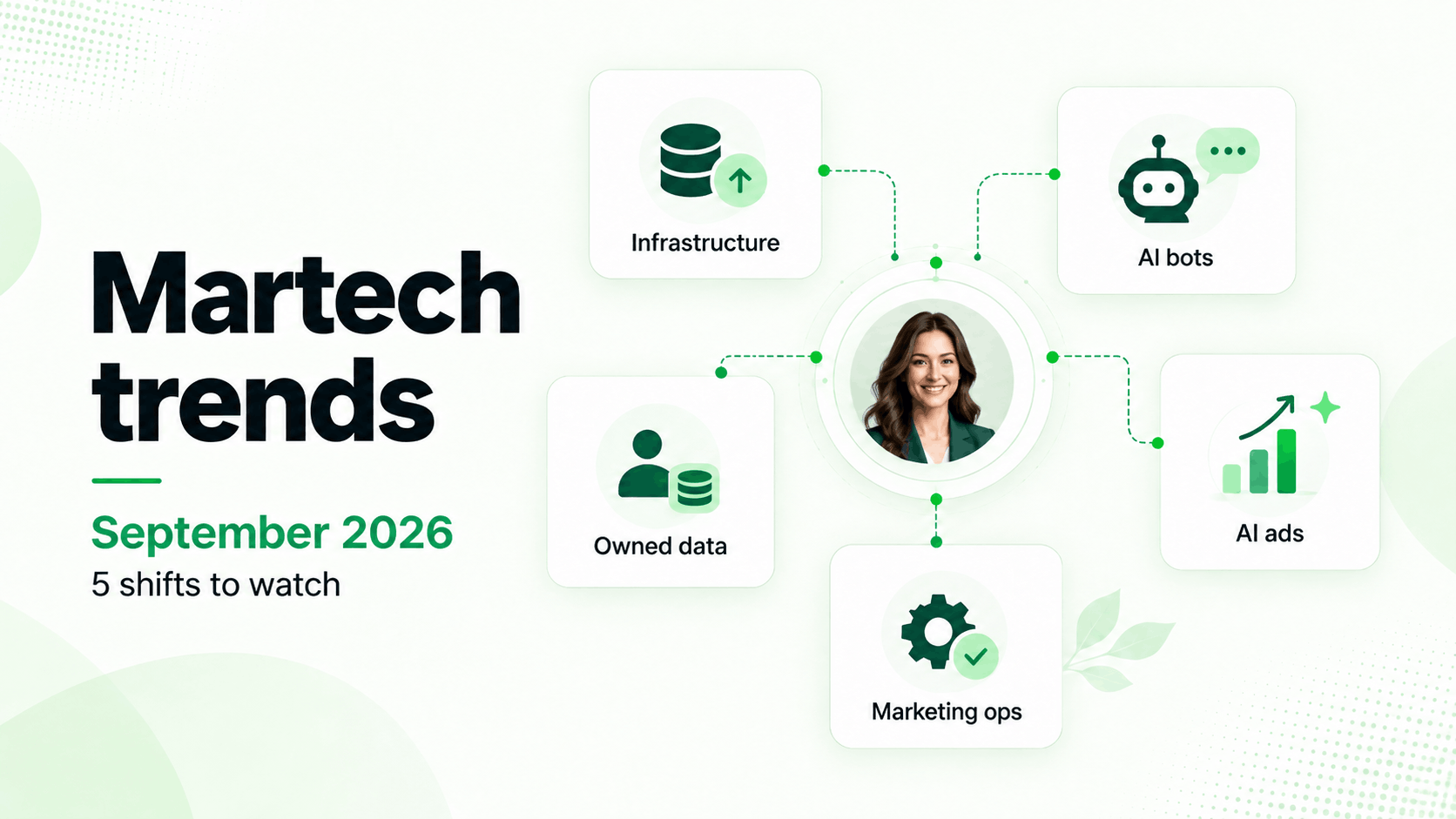
The five trends we have picked for autumn look quite different on the surface. There are bots shopping online, ads inside AI, a changing CMO role and another shift in how we think about the martech stack. Underneath, though, they are pointing in roughly the same direction.
Scott Brinker has argued throughout 2026 that martech is moving away from a collection of separate applications and towards infrastructure. In September, speaking to the ANA, he described AI as dissolving the traditional martech stack into a composable canvas, with agents increasingly working across tools rather than within one application.
For marketing teams, the practical consequence is that the workflow starts to matter more than the individual tool.
Take something as ordinary as an abandoned-cart campaign. Behavioural data may come from one system, product information from another, consent from somewhere else, and the final message may be sent through a separate automation platform. A marketer looking at the campaign sees one journey. Technically, several systems are involved in making it work.
That has always required a fair amount of internal knowledge. Most teams have people who know why a particular field feeds a particular segment, why one automation has an unusual delay, or what will stop working if the product feed changes. Much of that knowledge was never formally documented because a person could simply notice a problem and fix it.
Agents change that assumption. They can only work with the context they are given.
This is one reason an AI workflow can work very well in a controlled demo and become less reliable when introduced into a real marketing environment. The issue may have nothing to do with the quality of the model. The system may simply be missing information that the team has treated as common knowledge for years.
We have written before about what actually works in AI marketing automation. As companies move towards more agent-driven workflows, documenting how processes really work will become part of that job. Process knowledge is no longer only useful for onboarding or internal operations. It becomes context that AI needs in order to execute correctly.
Until recently, automated eCommerce traffic was mainly discussed as a security problem. Retailers were dealing with scrapers, credential stuffing, card testing and other forms of unwanted automation, so the obvious response was to detect bots and block them.
That is no longer enough.
AI bots accounted for 47.9% of commerce traffic across Akamai's global network in the second half of 2025. Adobe Analytics reported a 4,700% year-on-year increase in AI-driven traffic to US retail websites, while Radware found that bad bots had also increased, from 31% to 43% of holiday traffic. There is a useful overview of the authentication challenge, because the two developments are now happening at the same time.
Some automated traffic is still something retailers need to stop. Some of it may represent a customer trying to buy.
That makes authentication more complicated. It is not enough to know that a request came from an AI agent. Retailers also need to understand who the agent is acting for and what it has been authorised to do.
There is already evidence that this can create commercial value. Williams Sonoma says customers using Olive, its own AI shopping agent, convert at three times the rate of customers who do not use it. Home Depot has also expanded Magic Apron with store-level knowledge.
Both examples are worth noticing because the agent belongs to the retailer. The brand keeps the customer relationship and can connect the interaction with its own data, purchase history and loyalty context.
That is why agentic commerce will not be only a conversation about which AI model a retailer chooses. It will also depend on the customer engagement platform, identity layer and data infrastructure underneath it.
For eCommerce teams, the next stage of bot management is therefore less about blocking automation by default and more about deciding which automated actions can be trusted, under which conditions.
One of the most common arguments about generative AI is that it reduces differentiation. If everybody can generate similar content, build landing pages quickly and create campaign logic with AI assistance, then some of the advantages companies used to have become easier to copy.
That part is true. It does not mean all competitive advantage disappears.
In September, Brinker made the opposite case in his article on the unexpected upside to Martec's Law. His argument is that the advantages most likely to survive are the ones competitors cannot reproduce simply by using the same model.
The distinction between capability and asset is useful here. Generating campaign copy is a capability. So is building a segment or creating a landing page. The cost of accessing those capabilities is falling quickly.
Your purchase history is an asset. So is consented first-party data, long-term knowledge of customer behaviour, supplier relationships, returns history and the specific processes your company has developed over time. A competitor can buy the same AI model, but it cannot immediately recreate those things.
This also changes the way we should think about customer data. In our summer martech trends, we looked at the way CDPs are becoming context engines for AI. The competitive argument is a natural extension of that: when execution becomes easier to copy, the owned context underneath it becomes more important.
That is why unified customer data should not be treated only as a technology project. The important question is what the organisation can understand and do because that data has been collected, connected and maintained over time.
For some brands, AI will reveal an uncomfortable truth. If the only advantage was earlier access to a tool or a more efficient way of producing content, then the advantage was always temporary.
OpenAI has made advertising in ChatGPT considerably easier to buy and has projected $100 billion in advertising revenue by 2030.
It is an ambitious forecast. MarTech's assessment of the projection makes an important distinction: making advertising inventory available is not the same as proving that advertisers will eventually spend at that scale.
For marketing teams, that does not mean the channel should be ignored.
New advertising environments often offer useful learning opportunities before they become mature. Inventory can be cheaper, competition is lower and teams that start testing early can learn how users behave before the channel becomes widely adopted.
The important part is how the test is evaluated.
At this stage, AI-surface advertising does not have the measurement maturity of established paid search or social channels. Treating it as though it does can create unrealistic expectations. A small test budget with a clear learning objective makes more sense than moving a meaningful part of the media plan into the channel based on long-term revenue forecasts.
The same pattern has happened before with other advertising platforms. Early inventory often looks unusually attractive because the market has not yet decided what it is worth. As more advertisers enter, prices and performance settle into something more predictable.
That is why the first tests should answer basic questions. What does the audience look like? Which formats work? What happens after the click? How reliable is attribution? Does the traffic behave differently from users coming through other paid channels?
If those tests also produce good commercial results, even better. For now, though, the learning may be as valuable as the immediate return.
The final trend is less about technology itself and more about what the previous four trends mean for the people running marketing.
A September interview argues that the next generation of CMOs may come from marketing operations. A few years ago, that might have sounded like a deliberately provocative prediction. It is easier to understand now.
Modern marketing leadership increasingly requires someone to understand how data, systems and processes work together.
If agents are going to execute workflows, someone needs to know where the context for those workflows comes from. If customer data becomes part of competitive advantage, someone has to understand how that data is collected and activated. If a new AI advertising channel appears, someone has to decide how to test it without confusing experimentation with proven performance.
Creative judgement is still essential. So are brand understanding, customer insight and campaign instinct. The change is that these skills increasingly need to sit alongside operational and technical understanding.
For people already working in marketing operations, this creates a much clearer path into strategic leadership. The most valuable skill may not be the ability to automate the largest number of tasks, but the ability to decide which processes should be automated first.
That difference matters. It is perfectly possible to build a sophisticated automated workflow around something that contributes very little to the business while an important campaign still depends on somebody exporting a spreadsheet every Thursday.
We have previously written about automating in the right order. As agents take on more execution, sequencing becomes even more important. A good automation decision is no longer only about saving time. It determines which parts of the marketing operation become easier to scale.
Marketing operations has traditionally sat behind the visible work of marketing. Increasingly, it is becoming part of the decision-making that shapes the work in the first place.
None of these trends requires a complete rethink of the martech stack. They do suggest a few practical checks that are worth making now:
Document the processes that currently depend on knowledge held by only one or two people. If an agent is expected to work with that process later, that knowledge will need to exist somewhere outside their heads.
Check how much of your site traffic is automated and whether you can distinguish potentially useful buying agents from unwanted bots.
List the data, processes and relationships that competitors could not recreate simply by using the same AI tools.
Give AI advertising a small test budget and define what you want to learn before deciding what performance should look like.
Make ownership of each automation explicit, including who reviews it after launch and who is responsible for changing or stopping it.
Taken together, the five trends point to a fairly straightforward conclusion.
Marketing technology is becoming easier to access and many of the capabilities that once differentiated teams are becoming standard. That does not make the stack unimportant. It means the stack alone is less likely to be the reason one marketing organisation performs better than another.
The durable differences are increasingly found in the data a company has built over time, the processes it has learned to run well and the people who understand how those pieces fit together.
Those things are harder to demonstrate in a product demo. They are also much harder for a competitor to copy.



'AI-powered' used to mean something. Now it comes as standard on fridges.At some point the phrase stopped describing technology and started describing marketing. It's everywhere. Didn’t Dyson just add it to electric toothbrushes? It's also on every marketing platform in your shortlist, which is the part that should bother you, because you&#...
Read more
ANIA KRUK is a Polish jewellery brand founded in 2012 that continues the 180-year family jewellery tradition which speaks through their products, emphasising lightness, simplicity, and unforced elegance.
Read more
Marketing automation has become harder to evaluate precisely because almost every platform now sounds the same. More AI, more automation, more intelligence, more promises to do more with less. Some of that represents genuine progress. Some of it is familiar functionality with a new label. For ecommerce teams, the useful question is not which platform has the longest ...
Read more