Every platform says it's 'AI-powered' now: here's how to actually evaluate one

Manago AI is the new name for SALESmanago. Read our rebrand story here


'AI-powered' used to mean something. Now it comes as standard on fridges.
At some point the phrase stopped describing technology and started describing marketing. It's everywhere. Didn’t Dyson just add it to electric toothbrushes? It's also on every marketing platform in your shortlist, which is the part that should bother you, because you're about to spend real money on the strength of it.
The phrase now covers a text box that drafts subject lines and a system that can allocate your budget overnight. Same two words, two very different purchases. You probably got here after searching for the best AI marketing tools and finding ranked lists of AI marketing tools, none of which explained how to tell those two apart.
This isn't a ranked list. It's a way to tell the three kinds of AI apart, a decoder for the claims you'll read on every website, and the questions that reveal which kind any given AI marketing platform actually has. It works on full suites and on narrow AI tools alike, because it tests the claim rather than the category.
Every platform in this category added AI language at more or less the same time. Some shipped real capability. Others took features that had been running on rules and regression for years, changed the button colour, and 'artificially' called it intelligence. Both groups now describe themselves in identical words, and that's the problem.
No shock, the money's moving faster than the judgement. Gartner's 2026 CMO Spend Survey of 401 marketing leaders found CMOs putting 15.3% of budgets into AI while only 30% rated their AI readiness as mature, and around 70% admitted their own processes weren't mature enough to scale it. Budget reaches AI marketing tools well before the ability to judge them does.
There's a structural reason too. The genre that's meant to help buyers compare AI tools is the ranked list, and ranked lists reward breadth over interrogation. A roundup of the best AI marketing tools has too many products and too little room for each one. Enough to describe features, nowhere near enough to test them. So the claims go in unexamined, over and over, and everyone starts to agree with them.
None of this means the category's hollow. Plenty of AI marketing software does exactly what it says, and plenty of AI marketing genuinely works. It means the claim has stopped being evidence, and now whoever signs the contract has to be more informed. The AI tools haven't got worse. The language around them has.
Most articles about the best AI marketing tools sort by function: email tools, content tools, analytics tools. That’s rather useless for evaluation, because it tells you what a product touches rather than what it's allowed to do without you. Sort by autonomy instead.
Assistive AI shortens a job you were going to do anyway. You ask, it produces, you decide whether to keep it.
The eCommerce version goes something like, you need a batch of subject line variants for a sale, and what used to take an afternoon takes minutes. Content creation is the obvious win. The real one is the tedious middle of the job, the repetitive marketing tasks that produce nothing anyone remembers. Product descriptions. Category copy. Headlines for landing pages that have gone stale. The content marketing calendar. Metadata!
Content creation of this kind is now genuinely good, and the generative AI tools behind it have come a long way. Video generation has landed in enough platforms to be worth asking about. Where generative AI still struggles is anything needing taste, which is why the marketing content wants an editor rather than a rubber stamp.
What assistive AI doesn't do is decide. It has no opinion on whether the sale should run, who gets it, or when. Nothing reaches a customer unless a person puts it there. If a vendor's entire AI story lives here, that's not a scandal, but know it's the cheapest tier to build and the most heavily marketed.
Predictive AI reads history and scores the future: churn risk, lifetime value, likely next order date. Underneath is machine learning trained on your own transaction and behavioural data, which is why it can't work on day one.
The eCommerce version will feel like every contact carries a churn score, and the ones crossing a threshold drop into a win-back journey on their own. That's predictive AI doing the thing humans are worst at, spotting a pattern across your whole database at once. Customer segmentation stops being rules you maintain and becomes scores that update themselves, and the customer segmentation you end up with is usually one no human would've drawn.
This is where data analytics and prediction get blurred in demos. Data analytics tells you what happened last quarter. Prediction tells you what happens next, and the machine learning behind it should come with a statement of confidence. Good predictive analytics admits when it's uncertain, which separates serious AI marketing tools from dashboards with a new label. If a vendor shows you data analytics and calls it predictive, the tell is that everything on screen is in the past tense.
Again though, what it doesn't do is act. A score's an input. An automation you built decides what happens to a customer the model rates high risk rather than low.
Autonomous AI, sold as agentic AI or as AI agents, takes an outcome and goes after it. It chooses, executes and adjusts without being asked each time.
The eCommerce version is shaping up like you set a revenue target and the system picks the segments, the creative and the send time, then reallocates towards whatever's working mid-campaign. Nobody approves each step. This is marketing automation in a rather different sense from the marketing automation you already know, where you drew the flowchart and the software did as it was told.
What it doesn't do, in almost every product on the market, is operate without boundaries you set. Remember this when you’re comparing; most platforms have the first type, many the second, and the third is where vendors differ enormously while using identical language. Two products both calling themselves agentic can sit at opposite ends of a spectrum, one drafting a campaign for approval and the other spending money on its own judgement. No list of the best AI marketing tools will tell you which, because the feature name is the same in both.
| Type | What it does | What it means for you |
|---|---|---|
| Assistive | Helps you do a task faster. Writes a subject line, drafts copy, builds a segment from a prompt. | You stay in every loop. Output improves your speed, not your decisions. Value scales with how much routine production your team does. |
| Predictive | Forecasts what a customer will do. Churn risk, lifetime value, next order date. | You get better inputs, not fewer decisions. Needs your history, so value arrives on a delay and grows with data volume. |
| Autonomous / agentic | Decides and acts without being asked each time. | You're delegating judgement, not labour. The upside is speed at a scale people can't match. The exposure is that mistakes reach customers before you see them, so the controls matter more than the capability. |
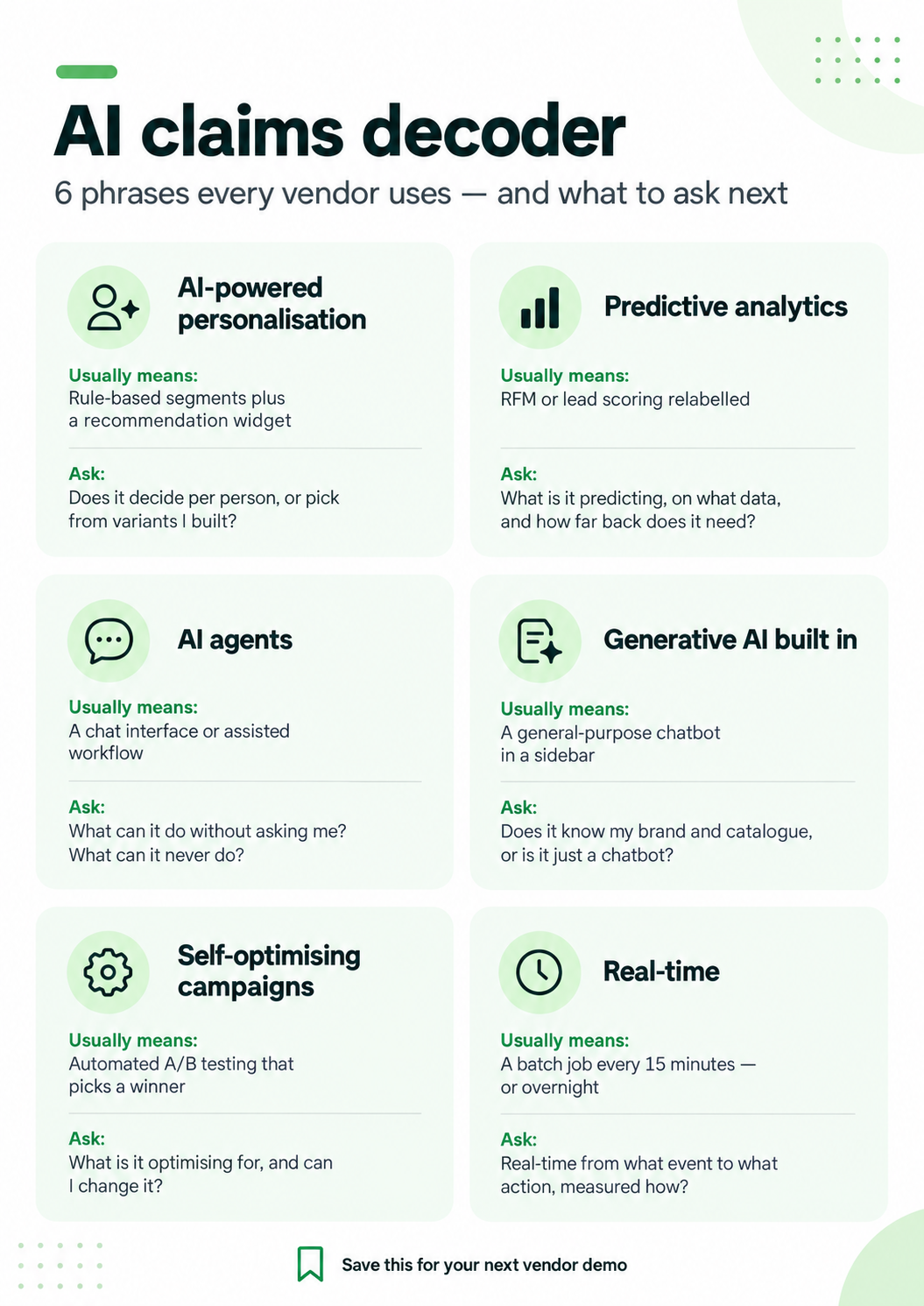
Every phrase below turns up in AI marketing tools sold to eCommerce teams, and in every roundup of the best AI marketing tools you've read this year.
Could mean: a model choosing, per person, in the moment, from your full catalogue, which product to show and which message to attach.
Usually means: rule-based customer segmentation with a recommendation widget added on. A handful of segments, a handful of variants, conditions somebody wrote once and never revisited them.
Ask: does it decide per person, or pick from variants I built? Then ask how many genuinely different things your customers would end up seeing. If it's a handful, you've got rules with a new name.
Could mean: machine learning working from your own history, producing scores you can use as triggers and filters, with stated accuracy and confidence.
Usually means: RFM analysis and lead scoring. Useful, well understood, and decades old.
Ask: what's it predicting, on what data, and how far back does it need? Vendors who know their models answer in specifics. Vendors who don't keep it vague and hope you'll move on. Any predictive analytics that works before you've given it history is a rules engine with better marketing.
Could mean: a system that executes multi-step work towards a goal, choosing its own steps.
Usually means: a chat interface running commands you type, or a workflow that drafts several things and stops. Both useful. Neither autonomous.
Ask: what can it do without asking me, and what can it never do? The second half matters more. A vendor who can't name what their AI agents are forbidden from doing hasn't thought about the controls, which is a rather larger problem than the answer they're avoiding.
Could mean: generation grounded in your assets, writing from your brand voice, your live product feed and your campaign history.
Usually means: a general-purpose model in a sidebar. The thing you've already got open in a browser tab, with their logo on it.
Ask: does it know my catalogue and my brand voice, or is it a chatbot in a panel? Test it there and then. Ask for a product email for a specific SKU, then check the price and the specification. Generative AI that can't see your data will invent both confidently.
Could mean: continuous reallocation towards a defined objective, with that objective visible and editable.
Usually means: automated A/B testing that picks a winner on open rate.
Ask: what's it optimising towards, and can I change it? Open rate and revenue produce very different behaviour. If nobody in the room can name the objective function, nobody in the room knows what the software does.
Could mean: an event reaches the profile and changes what a customer sees within seconds.
Usually means: a batch job that runs every fifteen minutes. Sometimes overnight.
Ask: real-time from what event, to what action, measured how? A cart abandonment that fires while the customer's still on site and a segment that refreshes overnight are both sold as real-time. Only one of them catches anybody before they close the tab.
Ask this first, about every AI feature they've named. Almost every vague claim in AI marketing collapses into clarity the moment somebody answers it.
A system that recommends produces something and stops. A person reviews, edits, approves, and only then does a customer see it. A system that decides acts on its own judgement and tells you afterwards, if it tells you at all.
A good answer comes back immediately, because a vendor who's built either one knows which. "It drafts the campaign and drops it into the editor for your team to approve" is a real answer. So is "it reallocates spend inside your guardrails, and you get a log."
A dodge sounds like flexibility. "It can do both, depending how you configure it." Usually that's a way of skipping the follow-up: what's the default, and who can change it? The default is what'll happen once the novelty's worn off and the person who set it up has moved on.
Your customers have the same instinct, incidentally. In a Gartner survey, willingness to let AI make the actual purchase topped out at 11%, and that ceiling was in the lowest-stakes categories. Letting AI narrow the choices ran to 31%. Recommend and wait, in other words.
Get specific about scope, because most AI marketing tools are vague here by default. Which decisions are in play: audience, creative, timing, channel, budget? Can it change a live campaign, or only build new ones?
Then oversight. Who signs off before an autonomous action goes live, is that person named in the system, and is the approval gate configurable per action type? You want a different threshold for a test send than for your entire database. Ask what the audit trail records, whether it survives a staff change, and whether there's an off switch a marketer can reach without raising a ticket.
Most disappointment with AI marketing tools traces back here rather than to the model. Which customer data does each feature need, and what happens when it's patchy? How long before a predictive model's worth trusting? What was it trained on: your account only, or pooled across the vendor's client base?
Then integration. How does this sit in your tech stack, and how much of the plugging in turns out to be your engineering team's problem? AI workflows that depend on customer data you don't collect aren't features, they're projects you're paying for. Ask which parts of your tech stack the AI workflows read from and which they write back to, because a system that can't write back is a reporting tool with ambitions.
Ask for a failure story, not a hypothetical. Every vendor with real deployments has one, and the willingness to tell it is itself the answer.
How do you find out, and how fast? Can you roll a decision back, or only stop the next one? If a model drifts, does anything alert you, or does campaign performance quietly sag for a quarter until somebody goes looking? Who's accountable when an autonomous action does damage, and is any of that in writing, or is it all in the relationship?
Pricing for AI tools here has moved fast, so be blunt about it. Are AI features included, tiered, or metered, and if metered, by what unit? What does a heavy month look like against a normal one? Software that charges by AI action can be excellent value and can also produce a bill nobody forecast.
Then the honest total. What internal time does this need every month, and who owns it after they leave? Marketing teams underprice this consistently, and a platform that needs a specialist you haven't got costs considerably more than its price tag.
The same logic condensed, for the claims you'll hear most often.
| The claim | The question to ask | What a real answer sounds like |
|---|---|---|
| AI-powered personalisation | Does it decide, or does it suggest and wait for me? | "It decides per profile from the full catalogue. Here are two accounts of the same size and how differently their customers saw the same campaign." |
| Predictive analytics | What is it predicting, on what data, and how far back does it need? | "Churn and 90-day purchase probability, trained on your transaction and event history. Roughly six months before scores stabilise, and the dashboard shows confidence until then." |
| AI agents | What can it do without asking me? What can it never do? | "It can build segments, draft creative and propose a schedule. It cannot send, change budget or alter a live journey without a named approver." |
| Generative AI built in | Does it know my brand and catalogue, or is it a chatbot in a sidebar? | "It generates from your product feed, past campaigns and a brand voice profile you configure. Give me a SKU and I will write the email now." |
| Self-optimising campaigns | What is it optimising towards, and can I change that? | "Revenue per recipient by default, configurable to four other objectives, and the current objective is visible on the campaign screen." |
| Real-time | Real-time from what event to what action, measured how? | "Web events hit the profile in under two seconds. Predictive scores recalculate hourly. Here is the difference on a live account." |
"Web events hit the profile in under two seconds. Predictive scores recalculate hourly. Here is the difference on a live account."
None of these prove a vendor's overselling, and several turn up in demos from products that belong on any list of the best AI marketing tools. Three in one demo, though, and you've learned something.
The demo runs on immaculate sample data. Perfect names, complete purchase histories, nobody who bought once and vanished. Ask what happens when a good share of your profiles have no purchase history at all. The hesitation before the answer tells you more than the answer does.
Nobody can say what the model was trained on. Not the architecture, which you don't need, but the data, which you do.
'The AI figures that out' arrives in response to a direct question. The most common tell in the category, and the most effective, because it reframes an unanswered question as a feature and most people let it go.
Results get quoted without a baseline. An uplift against what, measured over what period? Anyone comparing the best AI marketing tools should ask every time.
Everything is described as AI. When the reporting module, the form builder and the send scheduler have all been rebranded, the word has stopped meaning anything at all. Some of the best AI marketing tools are noticeably conservative about what they call AI, and that restraint is usually a huge green flag.
'Actionable insights' does a great deal of work and no question gets answered. Ask what action, by whom, on what screen. If nobody can walk it end to end, there are no actionable insights.
Integration gets waved through. AI tools that assume a clean tech stack tend to discover yours during implementation rather than during the sale, which is a discovery you pay for.
Nobody can name a limitation. Every serious vendor of AI tools knows where their product's weak, and the best AI marketing tools tend to come from the ones willing to say so, because it buys credibility for everything else.
Run a pilot on your own data. The gap between a demo and a deployment shows up precisely where a model trained on clean examples meets a catalogue that's been edited by everyone who's ever worked there.
Agree success criteria before you start, in writing, with numbers. Not "see how it goes". Pick two metrics, name the baseline, say what result makes this a yes.
Give predictive models runway. A churn model needs history behind it and time in front of it. A few weeks tests the onboarding, not the capability. Give it a full quarter and judge campaign performance at the end.
Test the failure path on purpose. Feed it a segment with sparse data. Approve something you'd normally reject and see whether anything flags it. Try to roll an action back. Point the content generation side at your worst landing pages.
Put one real person on it who isn't the champion. Ask whoever has to use the thing whether it saved them time or just moved the work elsewhere.
A pilot also does something no article can, including this one. It tells you which of the marketing strategies you already run would genuinely change if the AI marketing tools were better, and which wouldn't shift at all. Plenty of marketing strategies underperform for reasons no model can reach, and it's worth knowing which of yours those are before you sign.
Manago AI (previously SALESmanago) runs AI across five types: predictive, agentic, generative, recommendation and conversational. The structural point is that AI here is the execution layer on top of a customer data platform and marketing automation core, not the product itself. The scores and the drafts are only ever as good as the unified customer data underneath them, which is why the CDP comes first in the architecture.
Having spent an article handing you questions, it'd be poor form not to answer them ourselves.
Does it decide, or recommend and wait? It recommends and waits. The documented behaviour of our agentic AI is that it proposes, drafts and assembles, and your team reviews and approves before anything goes live. Nothing auto-launches. Every output, whether that's a segment, a campaign or a recommendation, lands in the editor fully editable, and you can reject it, edit it or replace it. There's an approval gate before every send.
That's a deliberate position rather than a missing feature. By this guide, that puts our AI agents closer to a capable assistive and predictive system than to autonomous spend allocation.
What data does it need? Predictive scoring, recommendations and generative AI output all run on live account data: your contacts, campaigns, segments and performance history, not generic patterns. Predictive AI and the marketing automation around it improve as that history builds, which is also why customer engagement tends to lift through sharper targeting rather than through more volume.
Tools solve one task. A platform runs the decision layer across all of them. The difference that matters is data: separate AI marketing tools each see a slice of the customer, a platform sees one profile. Most lists of the best AI marketing tools are lists of the former, which is why they can't help you evaluate the latter.
Both, and the split isn't random. McKinsey's State of AI survey of 1,719 respondents across 97 countries found 37% attributing at least some EBIT impact to AI, flat year on year, with only 6% reaching high-performer level. Adoption is near universal. Measurable impact isn't. The organisations getting returns scoped narrowly, measured against a baseline and fixed their data first, which is the least exciting advice in the category and the only bit that reliably works.
For predictive, yes. Machine learning given a thin slice of sparse events produces confident nonsense, which is worse than no answer because people believe it. For assistive work, no. Content creation, content generation and the everyday marketing tasks deliver from day one, because those AI tools aren't learning from you, they're producing drafts you edit. Video generation needs nothing from your history. Predictive scoring needs all of it. Sequence the rollout by capability, and judge each part against the content marketing it was supposed to speed up.
Anything irreversible, anything at full list scale, anything touching money. Discount logic, budget reallocation above a threshold, and any send to your entire database belong behind a human approval gate. This isn't distrust of the model, however good the AI marketing tools around it are. It's that the cost of the rare bad decision in those three areas dwarfs the time you saved by removing the click.
Stop comparing descriptions and start comparing answers. Take the four question groups into each demo, ask every vendor the same set, and put the responses in one document. The differences between the best AI tools here show up in how specific the answers get, not in the feature lists, which have been converging for two years.
There'll be another demo next week, and another rep promising more or less what the last one promised.
What's changed is that you can sort the claims into three buckets while the person is still talking, and that you've got one question that cuts through most of it: does this decide, or does it recommend and wait for me? Ask it early, and enjoy the show.
Good AI marketing tools survive that question comfortably. So do honest vendors selling modest capability, which is a perfectly reasonable thing to buy. The ones that don't survive it were never going to fit your marketing strategies anyway, and you've found that out before signing rather than after.
'AI-powered' will tell you nothing. What the software is allowed to do without asking you will tell you everything. If you want to see what that looks like in a platform where the approval gate is the default rather than a setting, that's what we've built.



ANIA KRUK is a Polish jewellery brand founded in 2012 that continues the 180-year family jewellery tradition which speaks through their products, emphasising lightness, simplicity, and unforced elegance.
Read more
For years, having the right martech stack could genuinely give a marketing team an advantage. One company had better automation, another had access to a platform its competitors had not yet adopted, and someone else had built a particularly effective setup around their CRM and campaign tools.AI is making that advantage less durable.
Read more
Marketing automation has become harder to evaluate precisely because almost every platform now sounds the same. More AI, more automation, more intelligence, more promises to do more with less. Some of that represents genuine progress. Some of it is familiar functionality with a new label. For ecommerce teams, the useful question is not which platform has the longest ...
Read more