Martech trends for October 2026: AI shopping, referral traffic and the trust problem behind the data

Manago AI is the new name for SALESmanago. Read our rebrand story here

Some of the AI ideas that spent the first half of the year in demos are now showing up in places marketers can measure: real customer journeys, referral reports and the platforms teams already use every day.
That makes this month's trends less about what AI might eventually do and more about where behaviour is already changing. Shoppers can complete more of the buying process inside AI interfaces. Referral traffic from those interfaces is becoming large enough to measure properly. At the same time, marketing platforms are changing how agents work together, while teams are having to think harder about which customer signals they can actually trust.
Five shifts stood out this month.
The idea of shopping through an AI assistant is quickly becoming less theoretical. Last month we looked at AI agents shopping on retailers' own sites. This month the movement runs the other way, with the purchase moving into the assistant itself.
In September, Tapestry made Coach and Kate Spade products available for purchase directly through Google's AI Mode and Gemini, with customers able to pay using Google Pay without being sent to a separate retailer site. Shopify is moving in the same direction with Agentic Storefronts, making merchant products available across AI channels including ChatGPT, Gemini and Microsoft Copilot. The exact checkout experience varies by platform, but the direction is becoming clear: product discovery and parts of the transaction are moving away from the traditional storefront.
That changes more than where the checkout button sits. When the purchase happens inside the assistant, product feeds, pricing and availability have to be right at the moment of sale, with no product page to correct them.
Brands are unlikely to lose their websites any time soon. What is changing is the assumption that the website will always be the place where discovery, evaluation and purchase happen in sequence. Increasingly, the brand needs to be ready for a customer who arrives halfway through that journey, or completes much of it somewhere else.
In August we looked at the first official data on AI visibility in Google Search. The next question is a commercial one: does that visibility send anyone to the site, and are they worth having?
Digital Commerce 360 reports that AI referrals were typically below 2% of referral traffic for large online retailers earlier in 2026, but are now closer to 5% for some businesses, with individual retailers reporting shares of 5–6% and expecting further growth. Adobe data cited by Digital Commerce 360 also found that AI-referred shoppers generated 53% more revenue per visit than other visitors.
Those numbers are still small next to traditional search, and they are not a universal benchmark. They are large enough, though, to stop putting everything under "other referral" and moving on.
The useful questions now look much more familiar. Which AI platforms are sending traffic? How does it convert? What does revenue per visit look like? Which pages do people enter through, and how far through the decision process have they already moved before they arrive?
This is where GEO starts to become a performance topic rather than only a content topic. Visibility matters, but the next step is understanding whether that visibility produces valuable customers.
AI is becoming part of product research, but shoppers do not automatically trust a recommendation simply because a model produced it.
New IAB research among 2,200 consumers who had recently used AI for shopping found that 56% preferred AI recommendations that included creator perspectives, while 65% said credible creator reviews made them more confident in AI-generated recommendations.
That is interesting because it complicates the idea that AI will make creator and review content less important. It may do the opposite.
A useful product review, specialist explanation or detailed customer experience is no longer valuable only to the person who reads it directly. It can become part of the evidence an AI system uses when helping somebody compare products. The same logic applies to AI product recommendations: the quality of the data and context behind a recommendation matters just as much as the model selecting the product.
There is a broader content lesson here. As generating basic information becomes almost free, the material that is difficult to manufacture at scale becomes more valuable: first-hand experience, credible reviews, expert knowledge and evidence that a product actually does what the brand says it does.
Much of the first wave of agentic marketing has been organised around individual agents. One writes content, another researches accounts, another builds a workflow. Now comes the next step, where the user describes the result they want and the assistant selects the specialist agents needed to complete the task.
This is a more important shift than simply adding another AI feature to a platform. Most marketers do not particularly want to manage a collection of digital workers. They want to get a campaign built, understand why revenue fell last week or decide which customers need a different message.
The interface may therefore become simpler while the system behind it becomes more complicated. A marketer describes the objective; the platform works out which data, tools and specialised agents are needed to get there.
That puts more pressure on the quality of the context underneath the system. The new part is authority: once one assistant hands work to several agents, someone has to decide which of them can change a segment, send a message or spend budget without asking first.
The interesting agentic question for marketing teams is gradually moving from "what can this agent do?" to "how well can the whole system coordinate the work?"
Marketing teams have spent years trying to collect and connect more customer data. AI adds a slightly uncomfortable twist: more signals do not necessarily mean more certainty.
Privacy changes already make some customer information harder to collect and unify. Data is spread across an increasing number of systems, and AI now adds generated and inferred signals alongside things customers have actually done or explicitly told the brand. MarTech has described this as a data trust problem: marketers have more information available, while becoming less certain about how much of it should drive an important decision.
The stakes rise once the same data starts feeding automated decisions. Bad data in a dashboard creates a bad report. Bad data feeding an autonomous decision can create thousands of bad decisions before somebody notices.
This makes provenance more useful than it used to be. Was a preference explicitly declared by the customer, observed from behaviour, predicted by a model or inferred by another AI system? How fresh is the signal? How confident are we in it? Can it be used for this particular decision?
A unified customer profile helps here when it records where each signal came from, so a declared preference and a model's guess are never treated as the same thing.
None of those questions are especially glamorous, but they are becoming part of what good AI marketing looks like. The next stage of customer data management may be less about collecting every possible signal and more about knowing which ones deserve to be acted on.
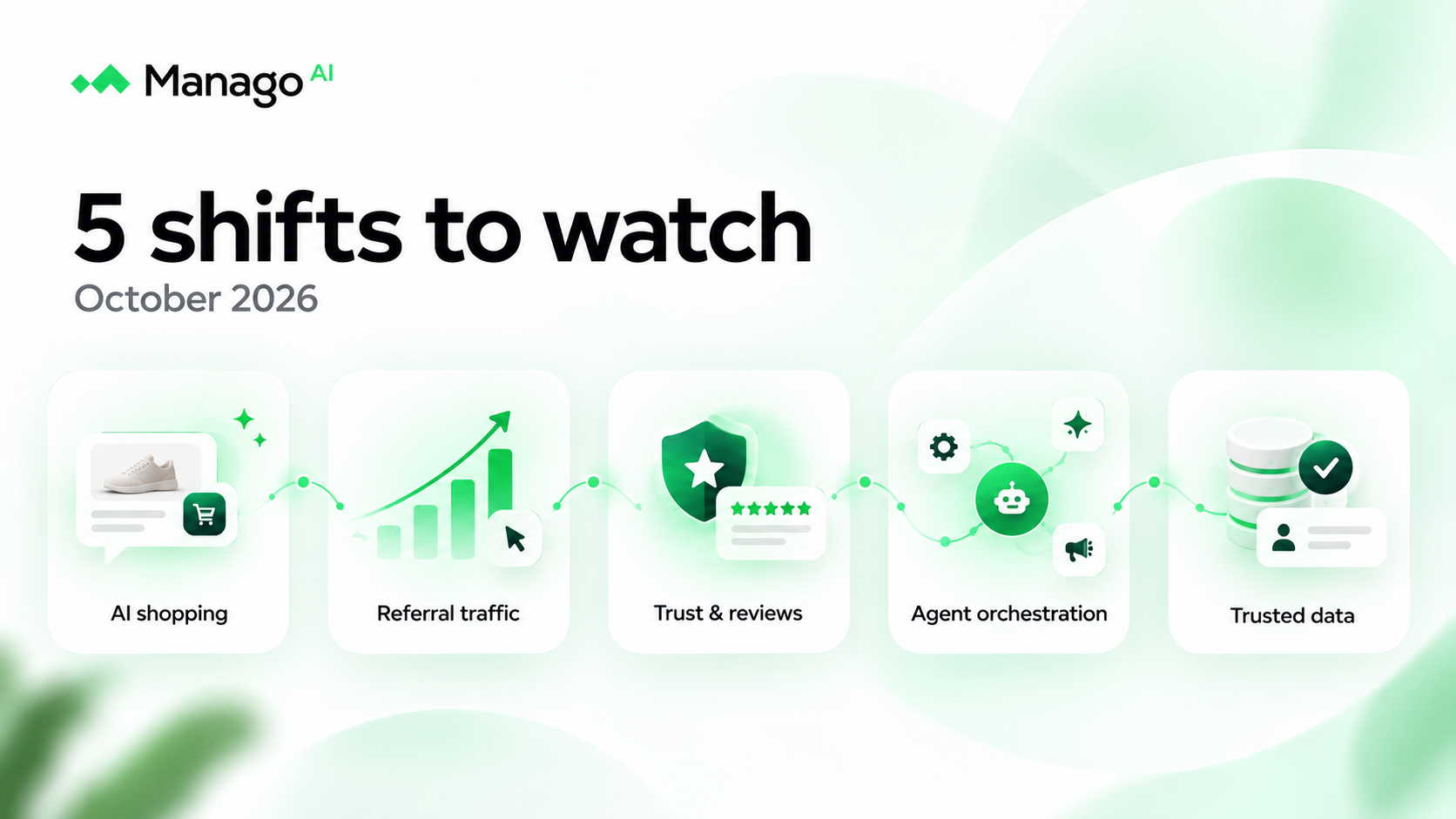
Put the five trends side by side and the customer journey looks harder to contain inside the systems and channels marketers are used to controlling.
Discovery can happen inside an AI assistant. The assistant can send a high-intent visitor to the site or, increasingly, help them buy without leaving the conversation. The recommendation itself may depend on reviews and expertise published elsewhere. Inside the marketing organisation, several agents may work together to decide what happens next, using a mixture of observed, declared and inferred customer data.
The opportunity is significant. The work that follows from it is mostly about limits: what AI should work with, which signals it should trust and where it is allowed to act.


From campaign email to CRM engine. How Beobasta moved from a Klaviyo-led newsletter rhythm to an AI-powered lifecycle marketing program on the Manago AI platform, covering automation, segmentation, consent capture and buyer exclusion.
Read more
France and Italy now require marketers to get separate consent before tracking how an individual recipient interacts with an email. In France the CNIL's recommendation has applied in full since 14 July 2026, and in Italy the Garante's rules take full effect on 29 October. Both cover the open-tracking image and the redirect links used to record clicks, so th...
Read more
A recommendation frame may look simple from the outside: six products shown to one customer at one particular moment. What appears in those six slots, however, is the result of several decisions made in sequence. Some belong to the recommendation model itself, while others are controlled by the strategy around it: which products are allowed into the frame, what happe...
Read more